State of B2B Outbound 2027: deliverability, replies and what agencies charge
Home › Blog › State of B2B Outbound 2027: deliverability, replies and what agencies charge
Our 2027 outbound report: DMARC across 478 fintechs, reply rates from 91,209 emails, what buyers ask first, and published agency prices. Free CSVs.
By Moe Alhosni · Published 31 October 2026 · 21 min read
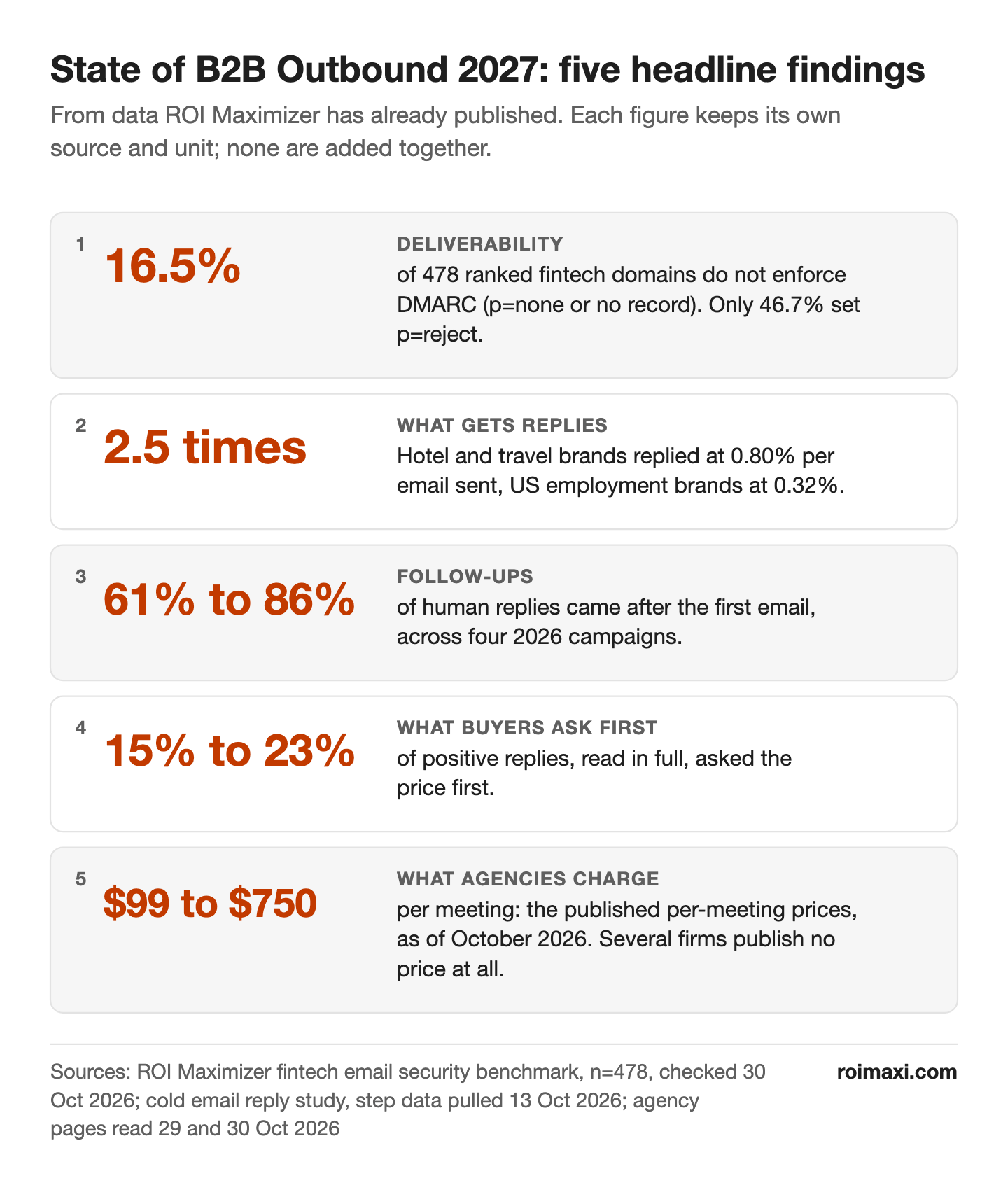
Short answer: As of October 2026, five findings from our published data. One in six ranked fintechs (16.5% of 478) does not enforce DMARC. Recipient industry moved human reply rates 2.5 times. Follow-ups produced most replies. 15% to 23% of positive replies asked the price first. And published agency prices run from $99 to $750 per meeting, or from $599 a month to $11,950 per four weeks. Each figure links its source below.
I'm Moe Alhosni, founder of ROI Maximizer (ROI Maxi). We run cold email for B2B companies and get paid per qualified meeting, and we are one of the agencies in the price section. So I gain when outbound looks like it works, and again when it looks hard enough to hand to someone else. Hold that against every number below.
This report adds no new data. It brings together five things we have already published, each with its own method, date and page: a DNS check of 478 ranked fintechs, four 2026 client campaigns' step data, an inbox export of positive replies, a full-text classification of those replies, and the prices agencies publish on their own websites. Each section names its source, and the method section says why the five are never added together.
The five headline findings
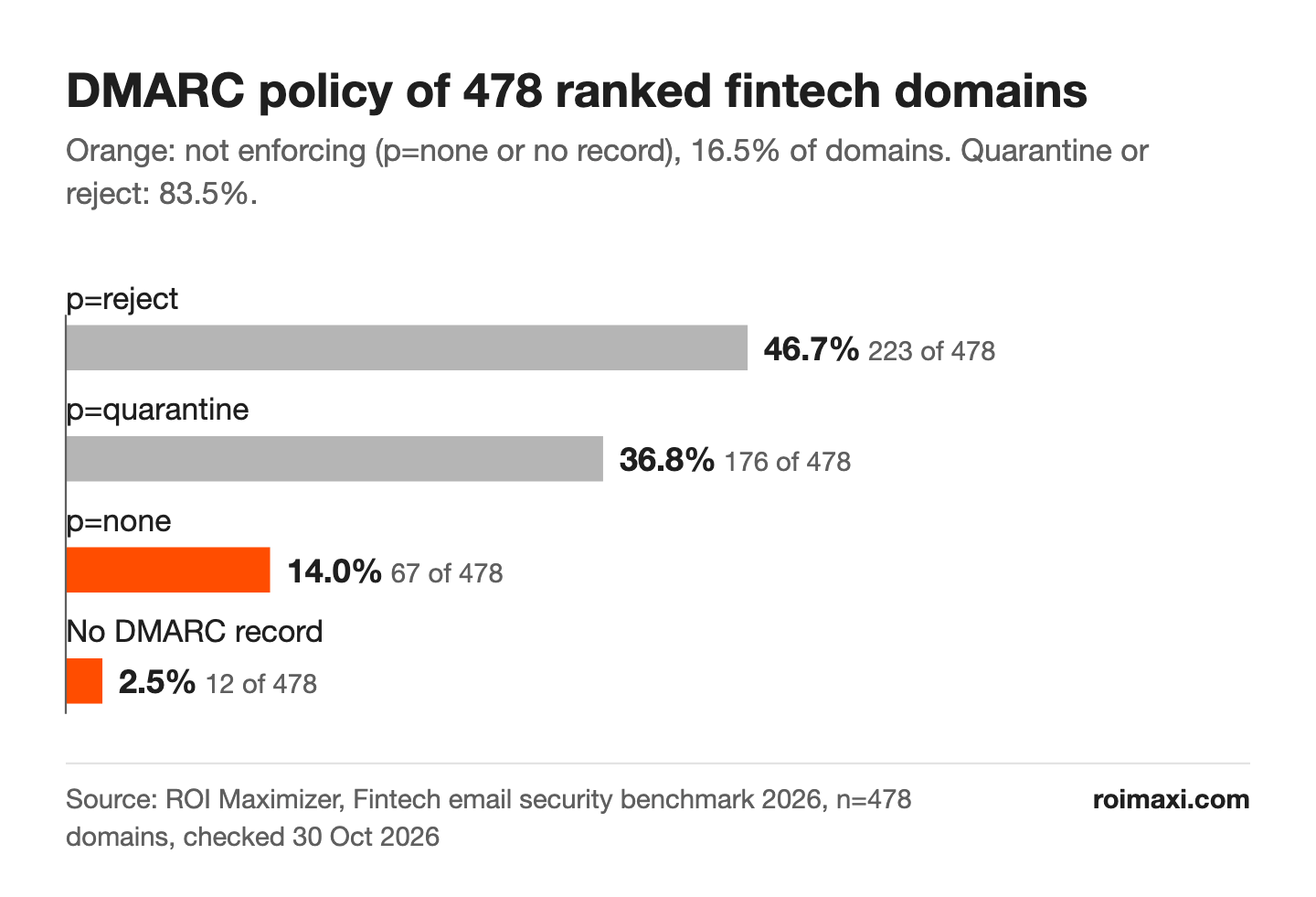
- Deliverability is mostly done, except the last step. 97.5% of 478 ranked fintech and financial-services domains publish a DMARC record, but only 46.7% set it to p=reject, and 16.5% (79 domains) have no DMARC or sit at p=none. Only 8.4% publish MTA-STS. Source: fintech email security benchmark 2026, checked 30 October 2026.
- Who receives the email moved the reply rate more than anything else we measured. Hotel, resort and travel brands replied at 0.80% per email sent (423 human replies on 52,955 emails sent). US employment brands replied at 0.32% (123 human replies on 38,254 emails sent): 2.5 times apart per email sent, 4.2 times per contact. Source: cold email reply rates by industry, step data pulled 13 October 2026.
- Follow-ups carry most of the result. Across four 2026 campaigns, the first email produced 14% to 39% of human replies and follow-ups 61% to 86%. Source: cold email statistics and how many follow-ups a sequence needs.
- Interested buyers ask for the price or for proof early. Read in full, 15% to 23% of positive replies asked the price first, depending on who received the email, and 20% of the positive replies to our own pay-per-result offer asked for proof. Source: reply study, what positive replies asked first.
- Agency prices are public for only part of the market. Published per-meeting prices run from $99 (ScaliQ's lowest) to $750 (Belkins' starting price), as of October 2026. Of twelve agencies scored on their own pages, three publish a per-meeting price, bill only meetings that took place and ask for no minimum term. Source: best pay-per-meeting lead generation agencies, read 30 October 2026.
How to read this report
Five sources sit behind the numbers. Each answers a different question, and each has its own unit.
| Source | What it counts | Size | Date | Where it is published |
|---|---|---|---|---|
| Fintech email security benchmark | Public DNS records of ranked fintech and financial-services domains | 478 domains | Checked 30 Oct 2026 | Benchmark |
| Step analytics | Emails sent and human replies of any sentiment, four 2026 client campaigns | 546 human replies on 91,209 emails sent | Pulled 13 Oct 2026 | Reply study and statistics |
| Positive-reply export | Unique people (all clients) who replied positively | 1,543 people | 7 Aug 2025 to 24 Jul 2026 | Positive reply rate benchmark |
| Full-text reply classes | Positive-reply events (one client excluded), each read in full | Three groups of 366 to 1,364 | Extracted 26 Jul 2026 | Reply study |
| Agency price pages | Prices and terms each agency publishes on its own site | 12 agencies scored, plus fintech-focused firms | Read 29 and 30 Oct 2026 | Pay-per-meeting agencies and fintech agencies |
A human reply is any reply a person wrote: yes, no or "remove me". Auto-replies are excluded. A positive reply is a reply labelled Interested in our Instantly workspace, set mostly by Instantly's AI classifier. A reply event is one message; a unique person is counted once. None of those is a meeting, and a meeting is not a qualified meeting until it matches a written definition, like the one in what counts as a qualified meeting.
Deliverability: the records that decide whether you land
Source for this section: the fintech email security benchmark 2026. On 30 October 2026 I checked the public email records of 478 companies from four rankings: CNBC and Statista's World's and UK's Top Fintech Companies 2025, the Forbes Fintech 50 2026 and Forbes Middle East's Fintech 50 2026.
| Measure | Share of 478 domains |
|---|---|
| Publishes a DMARC record | 97.5% |
| DMARC at p=reject | 46.7% |
| DMARC at p=quarantine | 36.8% |
| DMARC at p=none | 14.0% |
| No DMARC record | 2.5% |
| Not enforcing (no DMARC or p=none) | 16.5% |
| SPF over the 10-lookup limit (estimate) | 4.8% |
| DKIM key found on 10 common selectors (lower bound) | 96.4% |
| BIMI record | 27.6% |
| MTA-STS record | 8.4% |
| Grade A on our email setup checker | 72.4% |
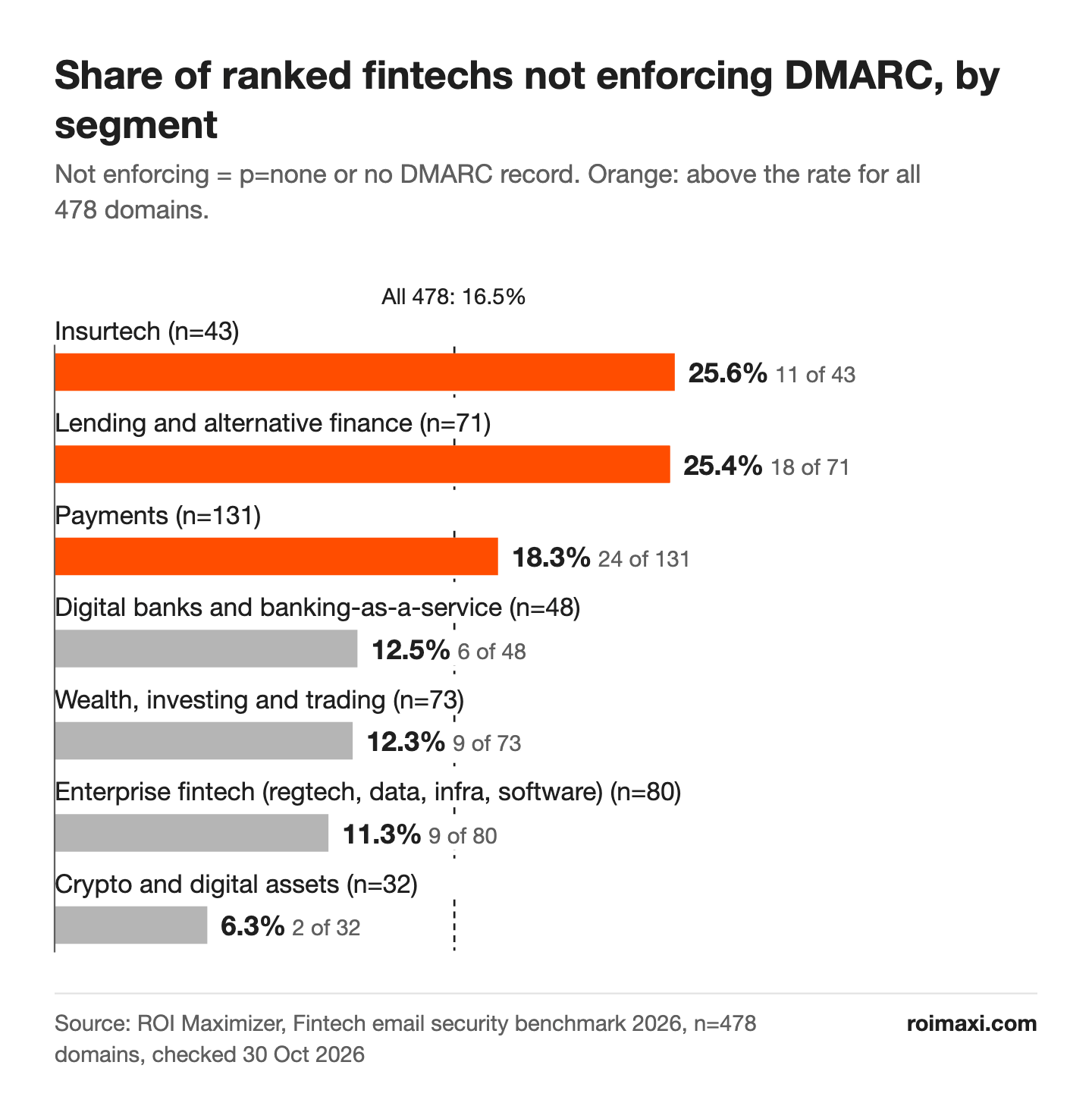
The gaps are not spread evenly. By segment, insurtech (25.6%) and lending (25.4%) lag, against 6.3% of crypto and digital-asset firms. By region, 36.5% of Middle East and North Africa fintechs do not enforce DMARC, against 13.3% in the United States and 12.9% in the United Kingdom.
Against other published studies, ranked fintechs are level with the Fortune 500 on enforcement. Red Sift's guide (updated January 2026) puts quarantine or reject at 81.2% for the Fortune 500, 74% for the FTSE 100 and 30.8% for 14,286 SEC-regulated firms; this sample is at 83.5%. Those studies use different samples and definitions, and award lists favour larger firms, so treat 16.5% as a best case for fintech, not an average. The comparison table and its sources are in the benchmark.
Why this belongs in an outbound report: the mailbox providers set the floor. Google has required SPF or DKIM from every sender since 1 February 2024, plus DMARC for anyone sending more than 5,000 messages a day to Gmail, with a spam rate below 0.10% and never 0.30% or higher. Yahoo's limit, from February 2024, is below 0.3%, and Microsoft's rules for domains sending over 5,000 emails a day to its consumer addresses took effect on 5 May 2025. All three are linked, with their dates, in cold email statistics.
Two more figures from our own audits sit on the same page. Two B2B clients' campaigns we audited on 8 October 2026 bounced 1.0% and 1.2% of emails sent, inside Instantly's advice to stay below 2%. The low bounce rate hid a bad list: 18% to 24% of the leads on each list named a company that did not match their email domain, most likely job-changers. A clean bounce rate is not a clean list.
What gets replies
Sources for this section: the reply study and cold email statistics, both from step data for four 2026 client campaigns, pulled 13 October 2026. These rates count human replies of any sentiment.
Published benchmarks first, because they disagree. As of October 2026, Belkins measured 0.45% per email sent in 2025 with auto-replies removed, and Instantly's 2026 report gives 3.43% for all replies per email sent. Smartlead's first-half 2026 median is 0.74% per contact, and Sales.co's study 2.09% per contact. Most of that gap is the denominator, which is why every rate below says what it divides by. The sources and their dates are in the published benchmarks table.
Our four campaigns drew 546 human replies on 91,209 emails sent, 0.32% to 1.00% per email sent by campaign. Grouped by who received the email:
| Recipient industry | Emails sent | Human replies | Per email sent | 95% interval | Replies per 100 contacts |
|---|---|---|---|---|---|
| Hotels, resorts and travel brands (3 campaigns, P1 Communications) | 52,955 | 423 | 0.80% | 0.73–0.88% | 4.4 |
| US employment and skills-first brands (1 campaign, PR Noir) | 38,254 | 123 | 0.32% | 0.27–0.38% | 1.1 |
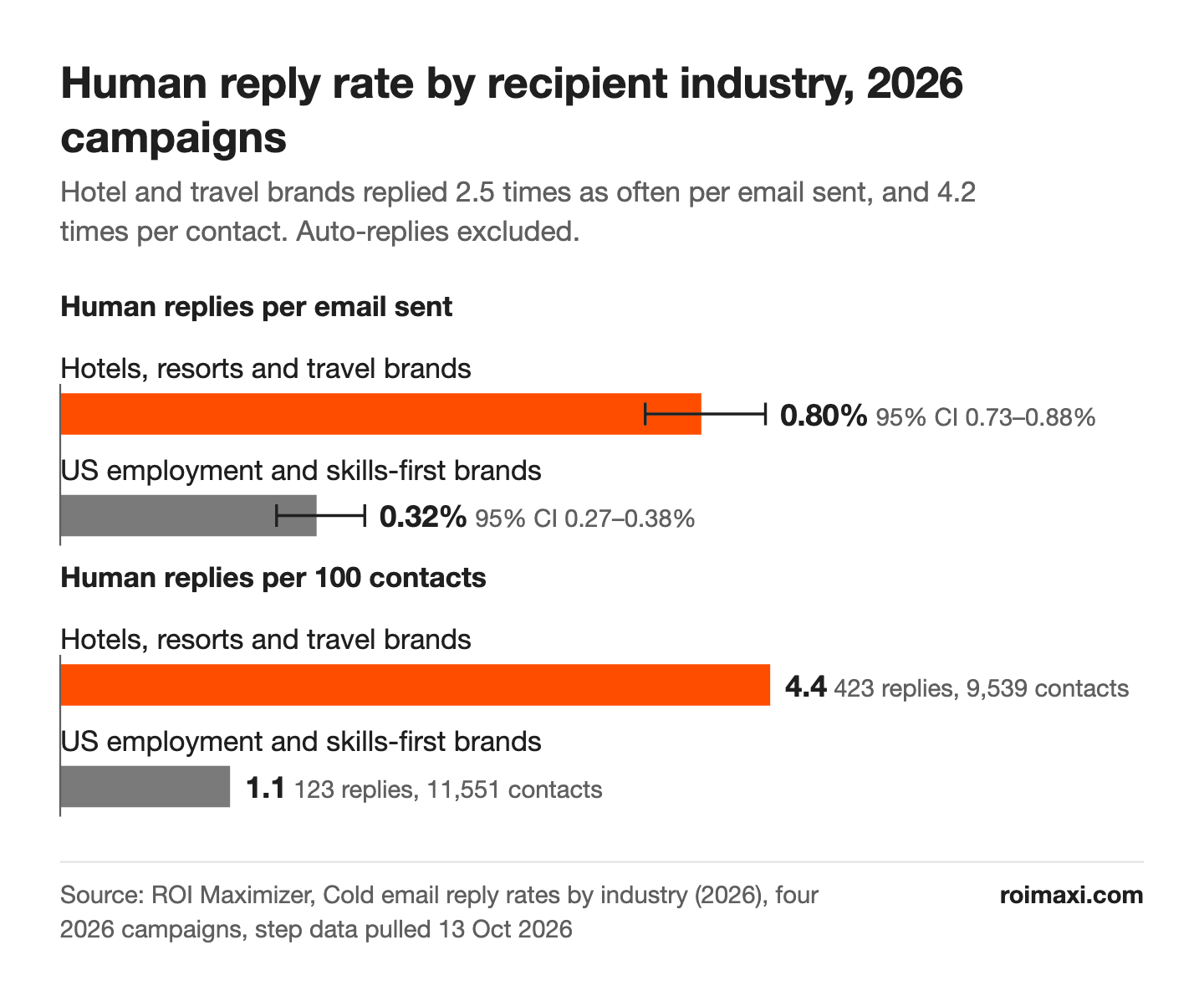
The gap is 2.5 times per email sent and 4.2 times per contact, because the hotel sequences ran seven or eight emails and the employment sequence four. Each industry here is one client, one offer and one list, so industry, offer and list quality move together. Read 2.5 times as what happened in these campaigns, not as a law about hotels.
The step data says what most outbound teams learn the hard way: the sequence matters more than the first email. In the hotel campaigns the per-email rate fell from 1.12% on the first email to about 0.7% by follow-ups 3 to 5, and to 0.42% at follow-up 6. In the employment campaign it hardly moved, from 0.34% to 0.28%. Across all four campaigns, the first email produced 14% to 39% of human replies and follow-ups 61% to 86%.
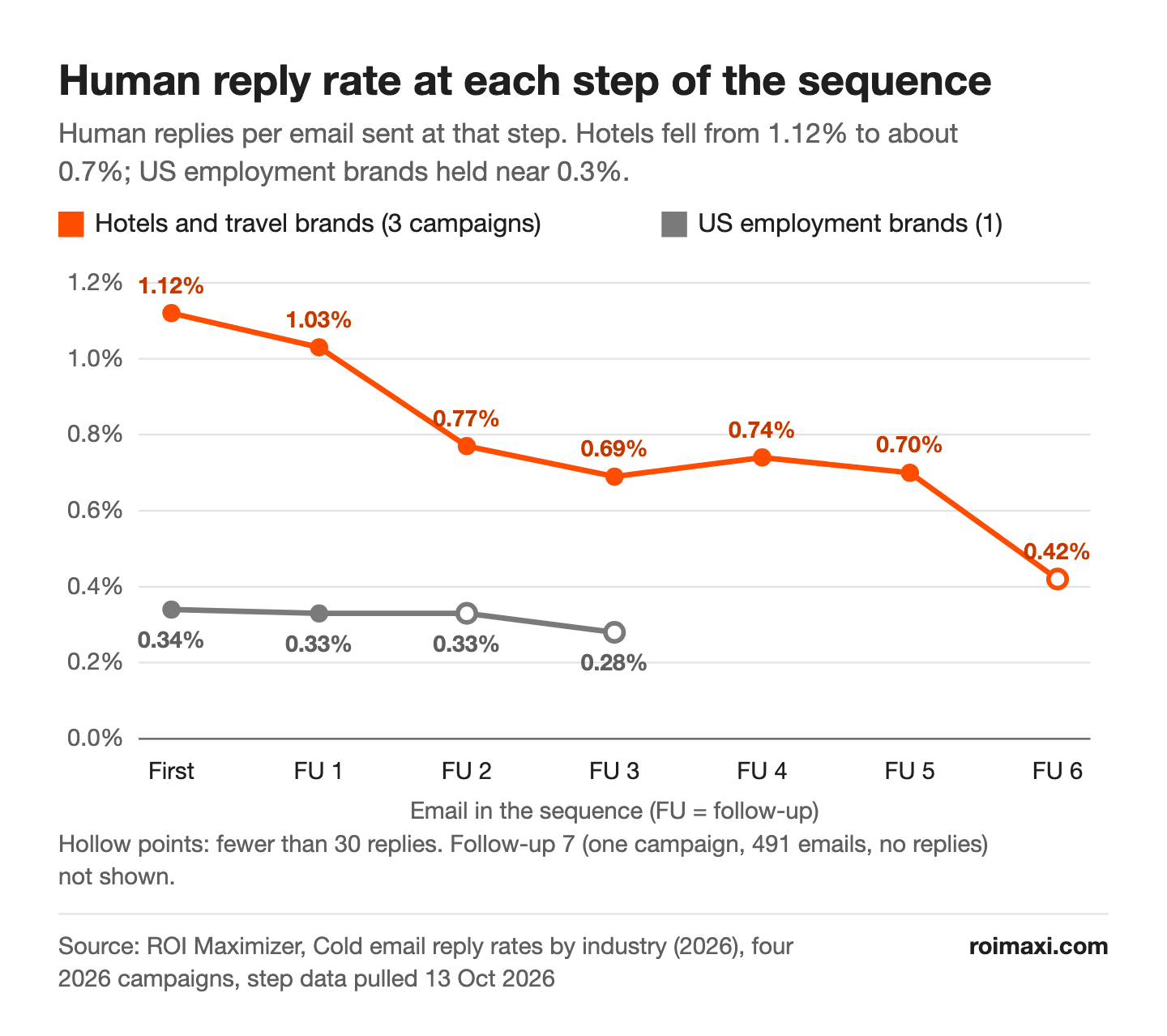
The inbox export points the same way from a different dataset. There, 32% of our own campaigns' positive-reply events came from the first email and 68% after it; a B2B PR client's four-step sequence got 66% from its first. Different measure, different campaigns, same direction. The breakdown is in cold email statistics and how many follow-ups a cold email sequence needs.
Short subject lines dominate the positive replies we hold. Of the 1,543 unique people (all clients) who replied positively between 7 August 2025 and 24 July 2026, the median subject line was four words, and 225 of them, 15%, replied to one line: question, {FirstName}. That is a share of people who replied, not a reply rate, because the export has no send counts. The detail is in cold email subject lines.
And the spread between campaigns is wide. Across 17 campaigns live at our 26 July 2026 snapshot, positive replies per contacted lead ran from 0.06% to 0.71%, and 8 of the 17 sat below 0.2%, the line where we stop and check the list and the offer. Source: positive replies per contact.
What buyers ask first: price and proof
Source for this section: the full-text reply classes in the reply study. These are positive-reply events (one client excluded), each classified from the whole reply, extracted 26 July 2026.
| Recipients | Replies | Asked for a call | Asked the price | Asked for proof | Asked for examples | Price or proof first |
|---|---|---|---|---|---|---|
| Hotels, resorts and travel brands (P1 Communications) | 397 | 34% | 15% | 4% | 7% | 19% |
| B2B and tech companies (a B2B PR client) | 366 | 34% | 23% | 3% | 12% | 26% |
| Agencies, Web3, finance and mixed B2B (our own campaigns) | 1,364 | 50% | 15% | 20% | 6% | 35% |
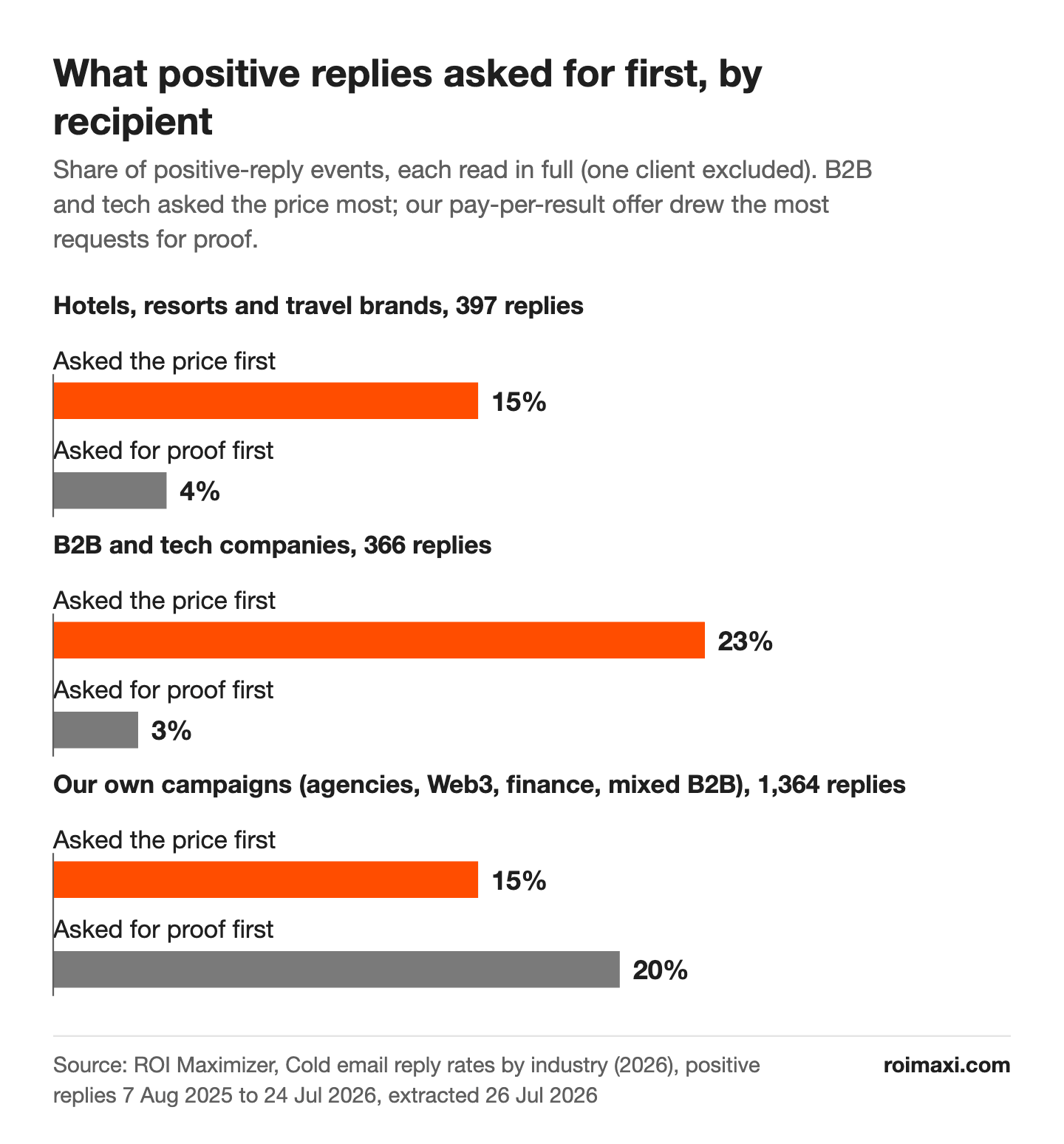
Three things follow.
Price comes up early. Between 15% and 23% of positive replies asked the price first. If whoever answers your inbox cannot state the price in an email, the warmest reply of the week gets "happy to jump on a call", and the buyer recognises the dodge.
An unusual offer needs evidence. Recipients of our own pay-per-result offer asked for proof in 20% of positive replies, against 3% to 4% elsewhere. My reading, which the data does not prove: an offer where you pay only for results sounds too good, so people want evidence before they book. Put one proof point in the follow-up.
A call is still the most common ask. Half of the positive replies to our own campaigns asked for a call, and 34% did in each of the two client groups. The reply-handling playbook is in how to reply to interested cold email replies.
Read from the short previews instead, the price share is lower. Of the 1,543 unique people (all clients) who replied positively, 7.4% led with a price question in the preview, and 10% in the finance and PE-VC data vertical. Previews stop before most people say what they want, so the full-text shares above are the ones to quote. Source: positive reply rate benchmark.
On proof, the most I can publish is this: PR Noir, a New York PR agency and a public client, got 27 leads, 10 qualified meetings and a $90K deal in its first 45 days. One client, one window. Don't multiply anything by it. The case study is at PR Noir.
What agencies charge: the price landscape
Sources for this section: best pay-per-meeting lead generation agencies, every figure read on the firm's own page on 30 October 2026, and fintech lead generation agencies compared, read on 29 October 2026. Each figure below is as the firm publishes it, with a link to its page. Our price watch fetched every one of these pages again on 31 October 2026 and found each figure unchanged. Prices move; the order form is the price.
There are two ways to buy outbound. A retainer charges a monthly fee whatever happens. Pay per meeting charges for meetings, and the word "meeting" is where the contracts differ.
Per-meeting prices, as published
| Agency | Price per meeting | Fixed fees | What it bills | Minimum term |
|---|---|---|---|---|
| ScaliQ | $99–$499 | No setup, no retainer | Attended | None stated |
| VA Horizon | $200–$600 | $300 setup | Held | "No contract to cancel" |
| ROI Maximizer (us) | $200–$500 | $1,000–$3,000 setup | Held, approved against a written definition | None |
| SalesGent | From $250 | None stated | Held; also calls the unit an opportunity | 3 months |
| FunnL | $300 | Retainer from $2,000 a month | "Completed", not defined | Not stated |
| Belkins | From $750 | Not stated for the plan | Not stated | Not stated for the plan |
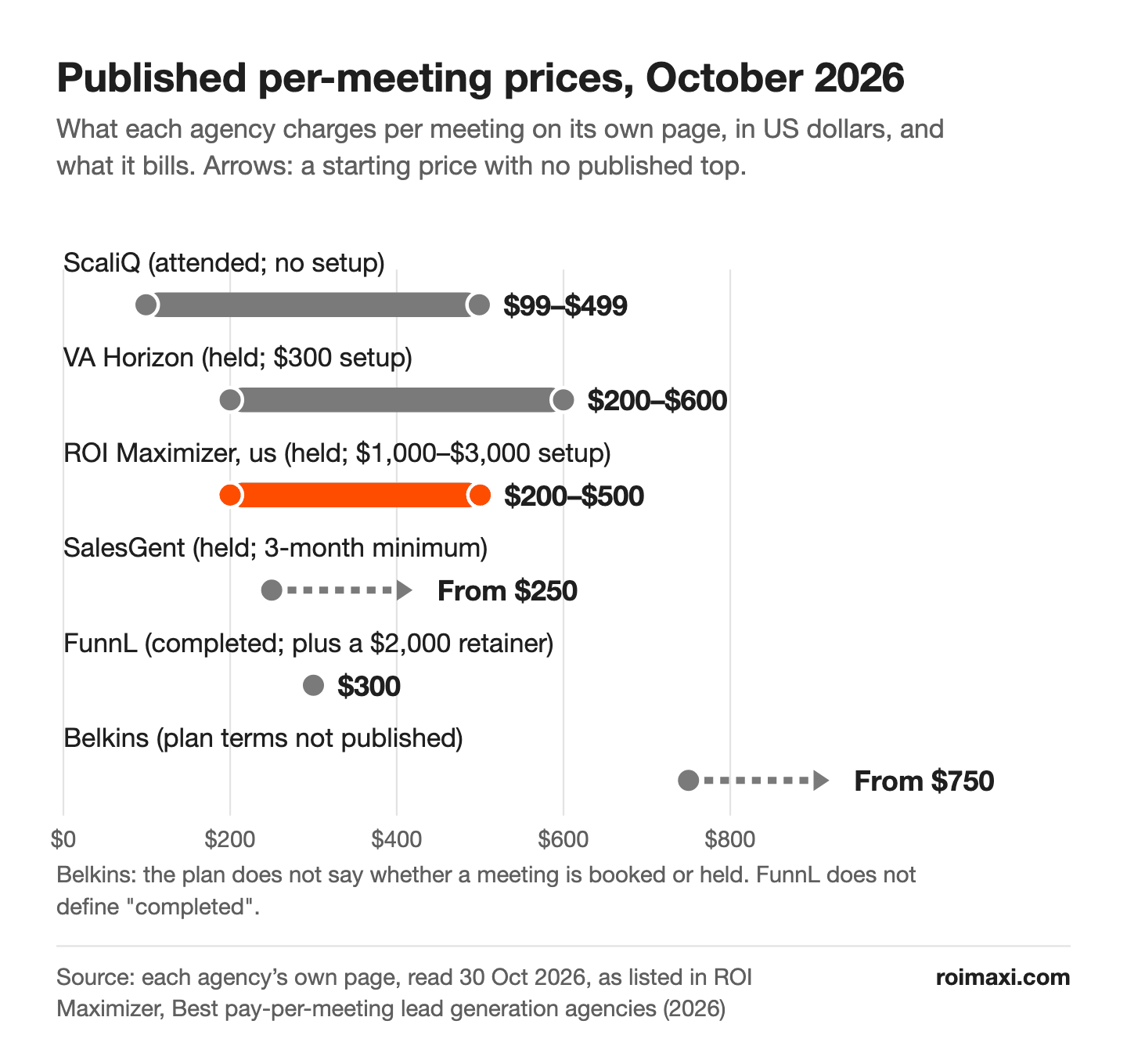
Published per-meeting prices run from $99 (ScaliQ's lowest) to $750 (Belkins' starting price). Two figures from outside the table frame the top end, and they are views of the market, not prices anyone charges: Belkins' CEO writes that a high-quality pay-per-appointment agency "might charge $600–$900 per qualified meeting", and Cleverly puts held appointments for enterprise and C-suite buyers at "$700–$1,000+". Both are linked, with their dates, in fintech lead generation agencies compared.
Monthly fees, as published
| Agency | Entry price, as published | What it buys | Term, as published |
|---|---|---|---|
| Modern Inbound | $599 or $899 a month plus GST, plus mailboxes and domains | Done-for-you outbound | Billed quarterly in advance |
| FunnL | From $2,000 a month, plus $300 per completed meeting | Retainer with a per-meeting fee | Not stated |
| Danish Lead Co | From $3,000 a month | One retainer, no setup fee | Not stated on that page |
| Sopro | Around €3.4K a month | Managed outreach | "no minimum contract" |
| CIENCE | $4,249 a month with one offshore SDR, before bonus; setup not priced | Campaign team, platform and SDR seats | Month to month |
| LeadHaste | $4,500 a month plus $1,000 setup | Retainer with a booked-meeting floor | 3 months, then month to month |
| Belkins | From $5,000 a month | Fintech starter package | 3-month pilot; retainer contracts six months with a three-month checkpoint |
| ROI Maximizer (us) | $5,000 a month flat, the alternative to per meeting | Cold email, no per-meeting fee | None |
| Callbox | $6,667 a month per pod, estimated | One SDR, campaign manager, data | Contract length on request |
| SalesRoads | $11,950 per four weeks for one SDR | Dedicated calling team | "Cancel anytime" |
Modern Inbound, Danish Lead Co and SalesRoads were read on 29 October 2026, the rest on 30 October. SalesHive and Martal Group publish no price to compare.
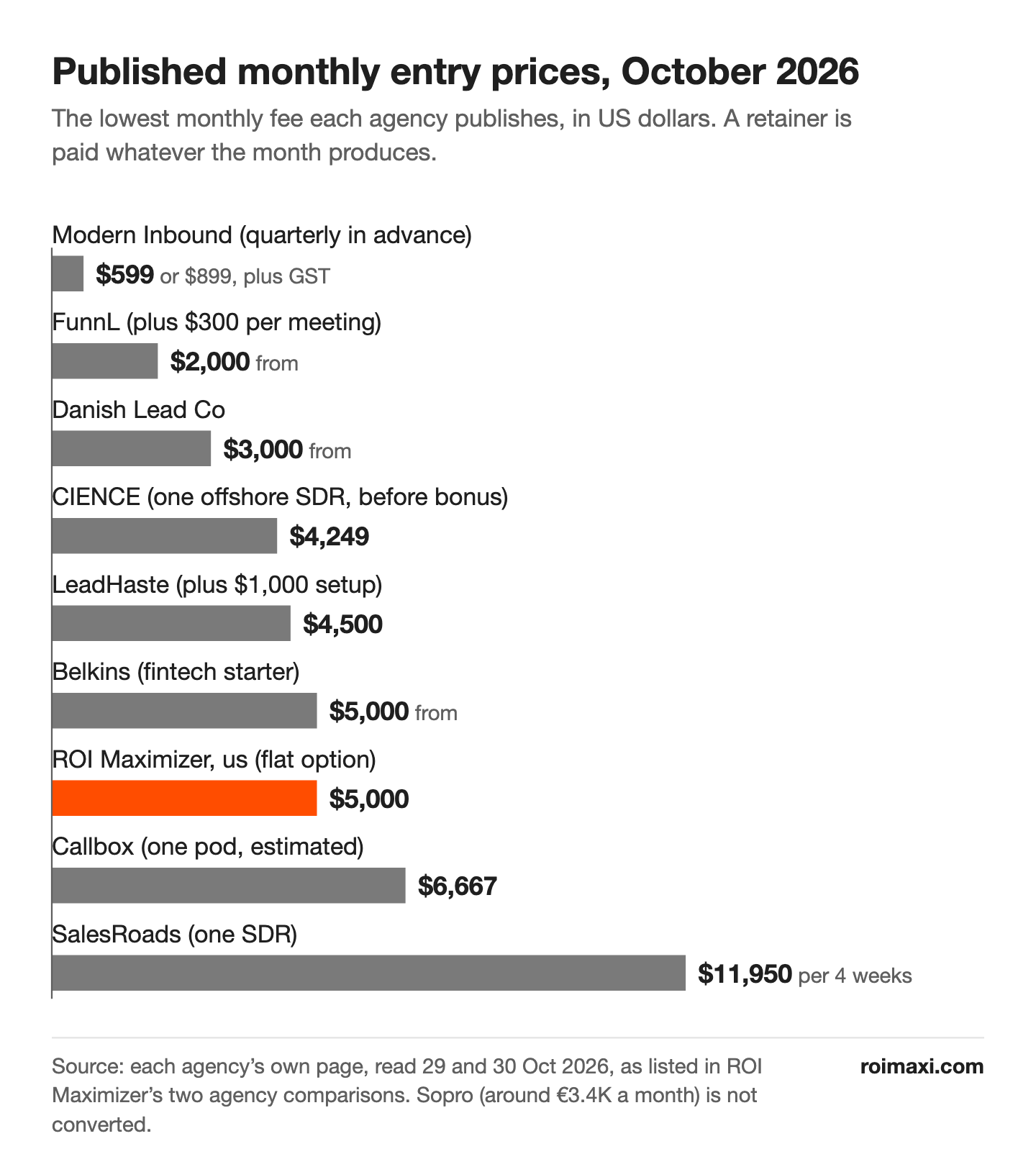
Three things the price tables show.
Most of the market sells time, not meetings. Of the twelve agencies scored in the pay-per-meeting comparison, six publish a per-meeting price, four say in their own words that they bill only meetings that took place, and three combine that with no minimum term: ScaliQ, VA Horizon and us. The rest charge a retainer or do not say what a meeting costs.
Minimum terms cluster at three months. SalesGent, LeadHaste and Belkins' fintech pilot all start at three months, Martal's pilot runs three months (four on higher tiers), and Belkins' retainer contracts run six with a checkpoint at three. Read the term and the notice period together: "month to month" with a full billing month after notice is longer than it sounds.
Compare on what a zero-meeting month costs. On a retainer you pay the fee whatever happens. Belkins' fintech starter lists 100 guaranteed appointments a year, about 8 a month, so at $5,000 a month that is roughly $600 per appointment, if the guarantee is met and if those appointments would pass your own qualification. Do the same sum for every quote with the cost per meeting calculator.
Our own terms, in full: a one-off setup of $1,000–$3,000, then $200–$500 per qualified meeting that took place, or a flat $5,000 a month. No minimum term and nothing for a no-show. Where you sit in each range depends on deal size, the list and the market. The detail is in pay per meeting lead generation pricing, and the trade-off between the two models is in pay per meeting vs retainer.
What to do in 2027
Nine things, each tied to a finding above and a free tool or guide.
- Check your sending domain first. If 16.5% of ranked fintechs still do not enforce DMARC, your own setup is worth ten seconds. Run it through the email setup checker, the same code the benchmark used.
- Send prospecting from a separate domain. Give it its own SPF, DKIM and DMARC, so a bad week of outbound cannot touch the domain your customers rely on.
- Move DMARC past p=none, then add MTA-STS. Read a fortnight of reports, fix the senders that fail, go to quarantine and then reject. Fewer than one in ten ranked fintechs publish MTA-STS, so it is an easy line in a security questionnaire.
- Check the list, not just the bounce rate. A 1.0% bounce rate sat beside 18% to 24% likely job-changers in our audit. Screen a list before it goes out with the lead list checker.
- Plan the volume your inboxes can carry. Work out mailboxes and domains for your send target with the cold email capacity calculator, and read cold emails per inbox per day for the limits.
- Write the follow-ups before the first email. Follow-ups produced 61% to 86% of human replies in our four campaigns. A sequence that stops after two emails throws most of that away.
- Have a written price answer and one proof point ready. 15% to 23% of positive replies asked the price first, and our pay-per-result offer drew proof requests in 20%. Both answers belong in the first reply, not on a call.
- Judge your rate against one counted the same way. Per email sent or per contact, auto-replies in or out. Published benchmarks run from 0.45% to 3.43% mostly because of the denominator.
- Price any agency on its zero-meeting month. Put every quote, your close rate and your deal size through the cost per meeting calculator and the ROI calculator before you compare. If you sell to financial institutions, check the rules first with the finance outbound compliance checker and read is cold email legal for financial services. This is general information, not legal advice; check with your compliance team or counsel.
Method and caveats
Five sources, never added together. Each section above uses one source, and each table names its unit. The DNS benchmark counts domains. The step analytics count emails sent, contacts and human replies. The positive-reply export counts unique people (all clients). The full-text classes count positive-reply events (one client excluded). The price tables count what agencies publish. A rate appears only where a denominator exists.
What each source can and cannot say.
- Benchmark: a one-day snapshot of 478 main web domains on 30 October 2026. Subdomains and separate sending domains were not checked, DKIM is a lower bound (ten common selectors), the SPF lookup count is an estimate, and award lists skew to larger firms. Groups under 20 are not reported, and no company's result is published. Full method in the benchmark.
- Step analytics: four 2026 campaigns for two public clients, P1 Communications and PR Noir. Each industry is one client, one offer and one list. Groups under 30 are suppressed, and rates on fewer than 30 replies are marked. Full method in the reply study.
- Positive-reply export: no send counts, so it gives shares and counts, never rates. The Interested label was set mostly by an AI classifier, and a few short export windows, none longer than a day, are missing. May and June 2026 are low because campaigns were paused during a platform migration, not because of seasonality.
- Full-text classes: our own campaigns and two client groups, not every market.
- Prices: list or starting prices as each firm publishes them, read on 29 and 30 October 2026. Your quote will move with segments, regions and channels. The counts of agencies by pricing model are counts of our published tables, not a market survey.
What none of it can tell you. Open rates (we send with open tracking off), a positive-reply rate per email sent, positive-reply rates by industry, seniority, or meetings per reply. The one published lead-to-meeting figure is PR Noir's: 27 leads, 10 meetings, 37%. I won't estimate any of the rest.
Clients named. Only clients whose case studies are public. Everyone else is described by market.
Refresh. The data pages are re-run on the first working day of each quarter, starting 4 January 2027, under the same rules. A figure that cannot be recounted the same way keeps its old value and its old date. Agency prices are re-checked on the same cycle.
Data downloads
- fintech-email-security-benchmark-2026.csv: the benchmark's aggregate tables, overall, by segment and by region. CC BY 4.0.
- cold-email-reply-study-2026.csv: every aggregate in the reply study, with numerators, denominators, units and 95% intervals. CC BY 4.0.
- The report as a PDF: this report with its charts, on A4.
- The fintech benchmark press kit: the DMARC charts as SVG and PNG.
Credit "ROI Maximizer (roimaxi.com)" and link this page. Keep each figure's label and denominator with it, and never add rows from different tables. For the method or anything else, email moe@roimaxi.com.
Citation: ROI Maximizer (roimaxi.com), State of B2B Outbound 2027, October 2026. https://roimaxi.com/blog/state-of-b2b-outbound-2027
Who wrote this
ROI Maximizer (ROI Maxi) is a B2B lead generation agency founded and run by Moe Alhosni. The team works from Warsaw, Poland; the company, M Ventures LTD, is registered in the UK. Before ROI Maximizer I spent four years and seven months at Moody's in London, most recently as Assistant Director, Sales, covering central banks, financial institutions, asset managers, PE and VC in Central and Eastern Europe plus Portugal, Malta and Cyprus. Nothing in this report comes from Moody's. More on the team is on about ROI Maximizer.
Frequently asked questions
What is a good cold email reply rate in 2027?
One counted the same way as yours. Our four 2026 client campaigns drew 546 human replies on 91,209 emails sent, 0.32% to 1.00% per email sent by campaign, auto-replies excluded. Published benchmarks run from Belkins' 0.45% to Instantly's 3.43%, mostly because they divide by different things.
Does recipient industry change cold email reply rates?
In our data, yes. Hotel and travel brands replied at 0.80% per email sent and US employment brands at 0.32%, 2.5 times apart. Each industry was one client with one offer, so part of the gap is the offer and the list.
How many fintechs enforce DMARC?
Of 478 ranked fintech and financial-services domains checked on 30 October 2026, 83.5% set DMARC to quarantine or reject, and 46.7% to reject. 16.5% have no DMARC record or sit at p=none.
How much do lead generation agencies charge in 2027?
As of October 2026, published per-meeting prices run from $99 to $750, and published monthly entry prices from $599 (Modern Inbound) to $11,950 per four weeks (SalesRoads, one SDR). Several firms publish no price at all. We charge $200–$500 per qualified meeting that took place after a $1,000–$3,000 setup, or a flat $5,000 a month.
Can I use the data in this report?
Yes. Both CSVs are free under CC BY 4.0. Credit ROI Maximizer (roimaxi.com), link this page, and keep each figure's label and denominator with it.
Before you sign with anyone
Get three things in writing before you pay any agency, including this one.
- What exactly is billed. Attended, held, completed, opportunity or approved: one word, defined. Ours is in what counts as a qualified meeting.
- No-show and reschedule terms. The answer should be "not charged until it takes place".
- What a month with zero meetings costs. On a retainer you pay anyway. On pay per meeting you pay nothing beyond the setup, and the contract should say so.
To vet any firm, us included, use how to tell if a lead generation agency is any good. If you want a second opinion on a shortlist, book 30 minutes or email moe@roimaxi.com.
About the author: Moe Alhosni, founder of ROI Maximizer. Before that he spent four and a half years in sales at Moody's in London, most recently as Assistant Director, Sales, working with banks, asset managers and private equity firms. He runs the campaigns behind the first-hand data on this site. LinkedIn
After Moody's he was Sales Director at Coinshift, a Web3 treasury management company (2024). Before Moody's he worked at BLOM Bank France in London on settlements and customer service, including AML/KYC record updates. Full career
Keep reading
- Why Cold Emails Get No Replies: Check the List Before Deliverability — Why cold emails get no replies: our October 2026 audit of two campaigns found 1 in 5 leads had most likely changed jobs. Deliverability was fine.
- Cold email templates: 36 that follow what got 2,333 positive replies — 36 cold email templates by situation: first emails, follow-ups, breakups, price, proof and replies. Each tied to a pattern in 2,333 positive-reply events.
- Lead generation for recruitment agencies and staffing firms: winning client companies — Lead generation for recruitment agencies: reaching hiring managers on live signals, the PECR points, our nearest data, and what it costs.
Or run the free GTM teardown on your own site for the ICP, cold email and numbers specific to your company.
ROI Maximizer is a trading name of M Ventures LTD, registered in England and Wales, company no. 15554493. Registered office: 4 Beau Street, Bath BA1 1QY, United Kingdom. moe@roimaxi.com
© 2024–2026 M Ventures LTD. Privacy notice · Editorial policy · Methodology · Corrections